How to Draw Activity Diagram
Create a UML activity diagram
Visio Plan ii Visio Paket 1 Microsoft Visio Professional 2021 Microsoft Visio Standard 2021 Visio Professional person 2019 Visio Standard 2019 Visio Professional 2016 Visio Standard 2016 Visio Professional 2013 Visio 2013 Visio Premium 2010 Visio 2010 Visio Standard 2010 Visio 2007 Lainnya...Kurang
A UML activity diagram in Visio looks like a flow chart. The flow of control is triggered by the completion of actions (or activities) within the system. The period may exist sequential, concurrent, or branched, indicated past shapes such equally swimlanes, forks, and joins.
Use an activeness diagram to depict how several activities are coordinated to provide a service or other end event. Activity diagrams can show how the events in a apply example relate to one another, or how a collection of use cases coordinate to represent a business workflow.
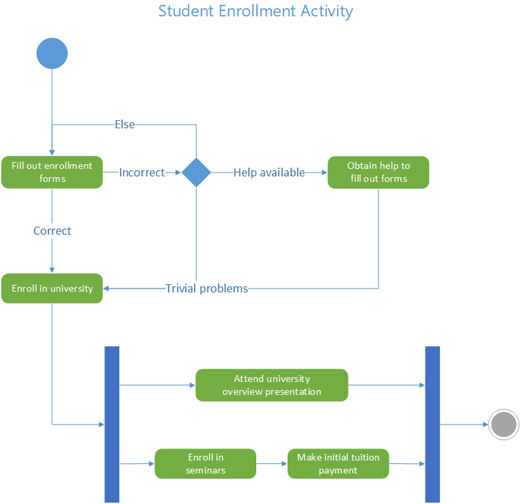
If you desire to stand for a menstruum in response to external events instead, use a country machine diagram.
Get-go an activity diagram
-
Starting time Visio. Or if you have a file open up already, click File > New.
-
In the Search box, type UML action.
-
Select the UML Activeness diagram.
-
In the dialog box, select either Metric Units or U.s. Units.
-
Select Create.
-
The diagram opens. You should see the Shapes window next to the diagram. If yous don't see it, become to View > Task Panes and make sure that Shapes is selected. If you nonetheless don't come across it, click the Expand the Shapes window button on the left.
-
On the View tab, make certain the check box next to Connection Points is selected. This option makes connexion points appear when you start connecting shapes.
-
Yous can now insert swimlanes and build the activity control menstruation in the diagram.
Pattern your diagram
-
If yous desire to indicate responsibility in the activity diagram, drag a Swimlane shape onto the page for each grade, person, or organizational unit y'all want to represent. To practice that:
-
Drag a Swimlane shape onto the drawing page.
-
Double-click each label on the shape to alter the default name.
-
Repeat steps a and b until yous've added all the partitions or organizational units you need.
-
Drag the side selection handles on the swimlane shapes to make the lanes the size y'all want.
-
-
Use the Initial node and Concluding node shapes to correspond initial and last pseudo states.
-
Add an Activeness shape for each action or activeness state you want to represent.
-
Use a Decision shape with guard conditions to point a possible transition from an activeness state.

-
Use the Fork node to represent the forking of one action state into multiple parallel states.
-
Use the Join node to correspond the synchronization of multiple action states into one state.
Start an action diagram
-
Open up Visio for the web.
-
Almost the upper right corner of the page, select More templates.
-
Search for UML Activeness or scroll down in the Gallery to the UML Activeness row.
-
Start with a blank UML activity template or a UML activity starter diagram. Select Create on the one you want to utilize.
Yous can now insert swimlanes and build the action control in the diagram.
Design your diagram
-
If you lot desire to indicate responsibility in the activity diagram, elevate a Swimlane shape onto the page for each class, person, or organizational unit of measurement you want to represent. To do that:
-
Drag a Swimlane shape onto the cartoon page.
-
Double-click each label on the shape to alter the default name.
-
Echo steps a and b until you've added all the partitions or organizational units you need.
-
Drag the side selection handles on the swimlane shapes to make the lanes the size yous want.
-
-
Use the Initial node and Final node shapes to stand for initial and last pseudo states.
-
Add an Action shape for each action or activity land you desire to represent.
-
Utilise a Conclusion shape with guard weather condition to indicate a possible transition from an activeness state.
-
Utilise the Fork node to represent the forking of one action state into multiple parallel states.
-
Utilize the Join node to represent the synchronization of multiple activeness states into 1 state.
Starting time an action diagram
-
Open the UML model diagram that contains the UML element for which you lot want to create an action diagram.
-
In the tree view, right-click the icon for the bundle, subsystem, class, operation, or apply case in which you want to create an activeness diagram. Betoken to New, and then click Activity Diagram.
A bare page appears, and the UML Action stencil becomes the top-most stencil. The workspace displays 'Action' every bit a watermark. An icon representing the diagram is added to the tree view.
Note:If the tree view is non visible, on the UML carte, point to View, and and then click Model Explorer.
Design your diagram
-
If you lot desire to indicate responsibility in the activity diagram, drag a Swimlane shape onto the folio for each course, person, or organizational unit of measurement you want to represent.
-
From the Activity stencil, elevate a Swimlane shape onto the cartoon page.
-
Double-click the shape to add together a name and other belongings values.
-
Echo steps a and b until you lot've added all the partitions or organizational units you need.
-
Elevate the side selection handles on the Swimlane shapes to brand the lanes the size you want.
-
Drag State, Action State, Object In State and Signal Receipt or Signal Transport shapes into the areas divers by the swimlanes and connect them using Control Flow and Object Flow shapes.
-
-
Elevate an Activity State or Land shape onto the drawing page for each action or activity state you lot want to represent. Use the Initial State and Terminal Country shapes to represent initial and final pseudo states. Work with state shapes in UML statechart and activity diagrams
-
Connect Command Flow shapes to Country shapes to indicate the change from i state to some other.
-
In an activity diagram, drag a Control Menstruum shape onto the drawing page.
-
Glue the Control Flow shape endpoint (without the arrowhead) to a connection point
on the source Activity State or State shape.
-
Glue the Control Flow shape endpoint (with an arrowhead) to a connection point on the destination Activeness State or State shape.
-
Double-click the Control Flow shape to add a transition string, including an event, guard condition, activeness expression, and more.
-
-
Apply the complex transition shapes, Transition (Fork) or Transition (Join), to stand for the forking of one action state into multiple parallel states, or the synchronization of multiple activeness states into one state. For more information, see Work with transition shapes in UML statechart and activity diagrams.
-
If you want to replace transition strings with point icons, use the Signal Send and Betoken Receipt shapes to represent the signals.
-
Double-click any shape to open its UML Backdrop dialog box where yous can add a name, transition cord, guard condition, deferred events, and other properties.
-
Save the diagram.
Run across Besides
UML diagrams in Visio
Create a UML state machine diagram
Create a UML use case diagram
Source: https://support.microsoft.com/id-id/office/create-a-uml-activity-diagram-19745dae-2872-4455-a906-13b736f01685
0 Response to "How to Draw Activity Diagram"
Post a Comment