Diana on the Stairs Philadelphia Museum of Art Logo Png
Photograph Caption: Photo Alec Rogers © 2016 for the Association for Public Art
-
Championship
Diana
-
Artist
Augustus Saint-Gaudens (1848 - 1907)
-
Year
1892; installed 1932
-
Location
Philadelphia Museum of Art, Great Stair Hall (interior)
-
Medium
Metallic, copper sail, hammered
-
Dimensions
Height xv'4.5" (base 1'half dozen")
Purchased past the Fairmount Park Fine art Association (at present the Clan for Public Art) and the Philadelphia Museum of Art
Owned past the Philadelphia Museum of Fine art
At A Glance
-
Please note that museum access (fee) is required to view this sculpture
-
In 1925, Diana was removed from Madison Foursquare Garden's famous old tower and placed in storage while the Garden gave way to a skyscraper built past the New York Life Insurance Company
-
She was brought to Philadelphia in 1932, after repairs at the Roman Bronze Works on Long Island for installation in the Peachy Stair Hall of the Philadelphia Museum of Art
-
In 1967, when another Madison Square Garden was being built, the Mayor of New York wrote Mayor James Tate of Philadelphia requesting her return to the city, but Mayor Tate refused
The old Madison Square Garden (1892 -1925) in New York was designed by McKim, Mead & White. Saint-Gaudens created Diana as a tribute to his friendship with Stanford White of that business firm. This was Saint-Gaudens's first large-scale nude, his showtime ideal figure, and the thirteen-human foot maiden became the perfect finial for the Garden'south famous old tower. Diana is the Roman goddess of the hunt, and here stands nude, balanced on one foot on a copper ball, with bow and pointer poised to shoot. A flowing cloak, as well of sheet copper, which aided in her office as a weathervane, was ripped off in a storm in 1905.
"When no 1 wanted this poor little orphan, Philadelphia took her in, gave her a deluxe home and created a beautiful image for her with a world-wide reputation" – Mayor James Tate
As protectress of the various exhibitions and shows, she spun in a higher place the convention grouping to nominate William Jennings Bryan for President, and, ironically, was a near witness to the shooting of Stanford White past Harry Thaw in 1906 in the rooftop café under her feet. She brought a special quality to New York and was immortalized as a landmark in O. Henry's story "The Lady College Up," when the author had Bartholdi'due south Liberty say to Saint-Gaudens'sDiana "Ye accept the best job for a statue in the whole town."
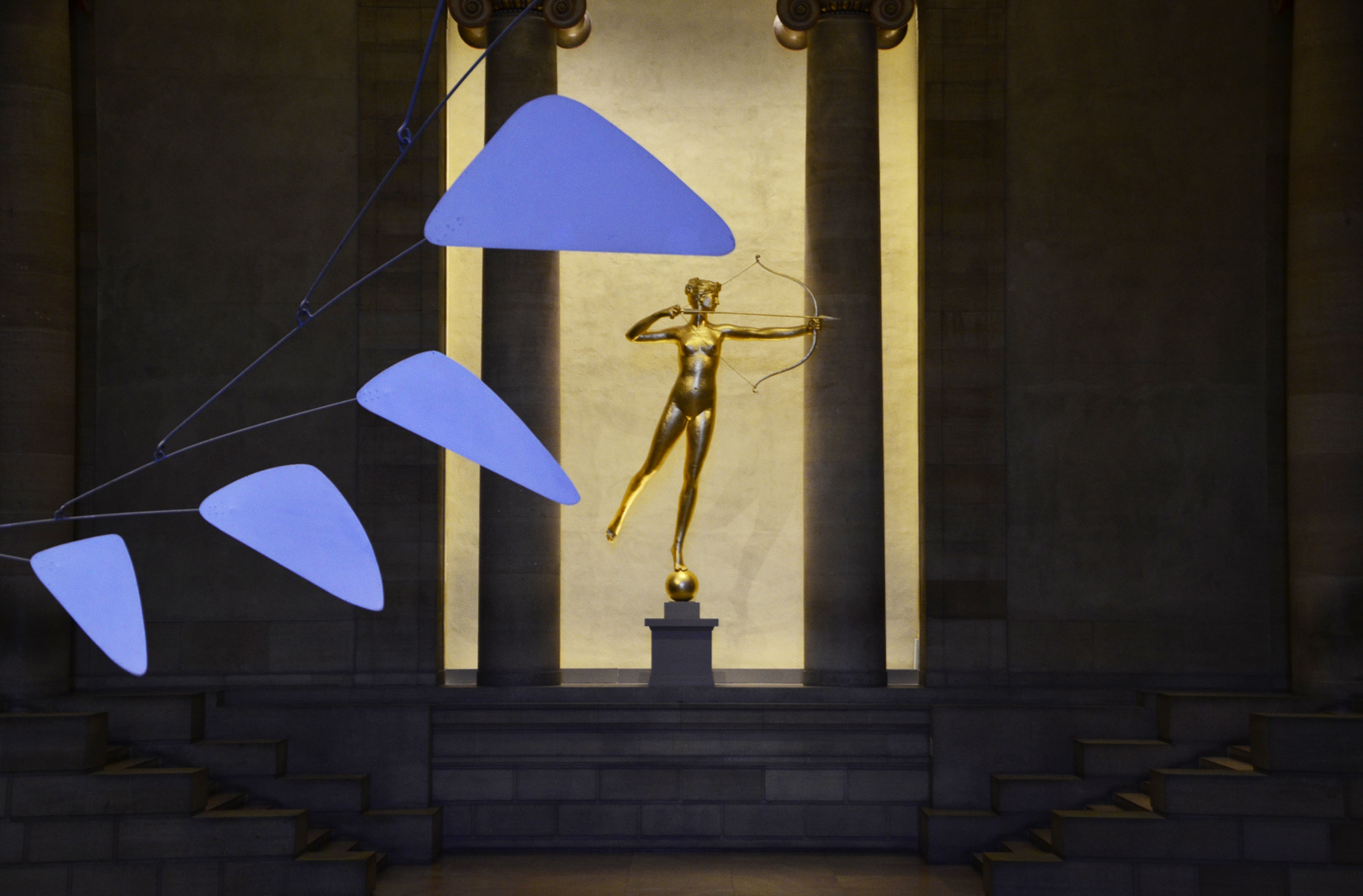
On May 5, 1925, Diana was removed and placed in storage while the Garden gave way to a skyscraper built by the New York Life Insurance Company. Finally, through the efforts of Fiske Kimball, director of the Philadelphia Museum of Art, and funds provided by the Fairmount Park Fine art Association (now the Clan for Public Art), she was brought to Philadelphia in 1932, later repairs at the Roman Bronze Works on Long Island, for installation in the Groovy Stair Hall of the Philadelphia Museum of Art. The Reverend Mary Hubbert Ellis, a "crusader against pornography," tried to prevent the entry into the metropolis of a statue that was "brazen, ungarbed and unfit for public view."
Since so, New York has made attempts to recover Diana. She was requested to attend the Earth's Fair in 1939, just declined. In 1967, when another Madison Square Garden was being built, the Mayor of New York wrote Mayor James Tate of Philadelphia requesting her return. Mayor Tate replied: "Would you really desire me to believe that you would give Manhattan dorsum to the Indians if they returned the $24 you paid for it? When no one wanted this poor piddling orphan, Philadelphia took her in, gave her a palatial home and created a beautiful image for her with a world-wide reputation."
Adapted fromSculpture of a City: Philadelphia's Treasures in Bronze and Stone by the Fairmount Park Fine art Clan (now the Association for Public Art) (Walker Publishing Co., New York, 1974) andPublic Art in Philadelphia by Penny Balkin Bach (Temple University Press, Philadelphia, 1992).
Resources
- How to Request Images
Loading map...
More artworks
Source: https://www.associationforpublicart.org/artwork/diana/
0 Response to "Diana on the Stairs Philadelphia Museum of Art Logo Png"
Post a Comment